

In this article
- GEO vs SEO in One Line
- The Side by Side Comparison
- Where GEO and SEO Genuinely Overlap
- Where They Genuinely Diverge, and What the Research Actually Supports
- Do Indian Businesses Actually Need Both?
- How to Run SEO and GEO Together Without Wasting Effort
- What GEO Costs in India Right Now
- Frequently Asked Questions
- Conclusion
Open any “GEO vs SEO” guide published this year and you will notice a pattern. Most are written by seo company selling GEO retainers, so the split between the two disciplines tends to get pitched as bigger and more urgent than the evidence actually supports.
This article does something different. It compares GEO and SEO across the dimensions that matter to a working marketer, and it checks the most commonly repeated claims against actual peer reviewed research, not just industry decks.
If you already read the full research breakdown of Generative Engine Optimization in our pillar article, this piece zooms in on one question that article only touched briefly: how different is GEO from the SEO you are already doing?
Key Takeaways
- SEO wins a ranking position, GEO wins a citation inside an AI generated answer, and the two share roughly 60 to 70% of their groundwork (upGrowth, GEO vs Traditional SEO guide, 2026).
- In one peer reviewed audit, 53% of domains cited in Google AI Overviews did not appear in Google’s own organic top 10 (Kirsten et al., cited in Martinez, “A Critical Survey of Generative Engine Optimization,” arXiv:2607.14035v1, 2026).
- Optimising narrowly for AI citations can backfire. One large study found body only rewrites cut top 10 presence by roughly 16% after reranking (Kim et al., SAGEO Arena, cited in arXiv:2607.14035v1, 2026).
- Most Indian businesses with meaningful organic search dependency need both, run as connected but separately measured efforts.
GEO vs SEO in One Line
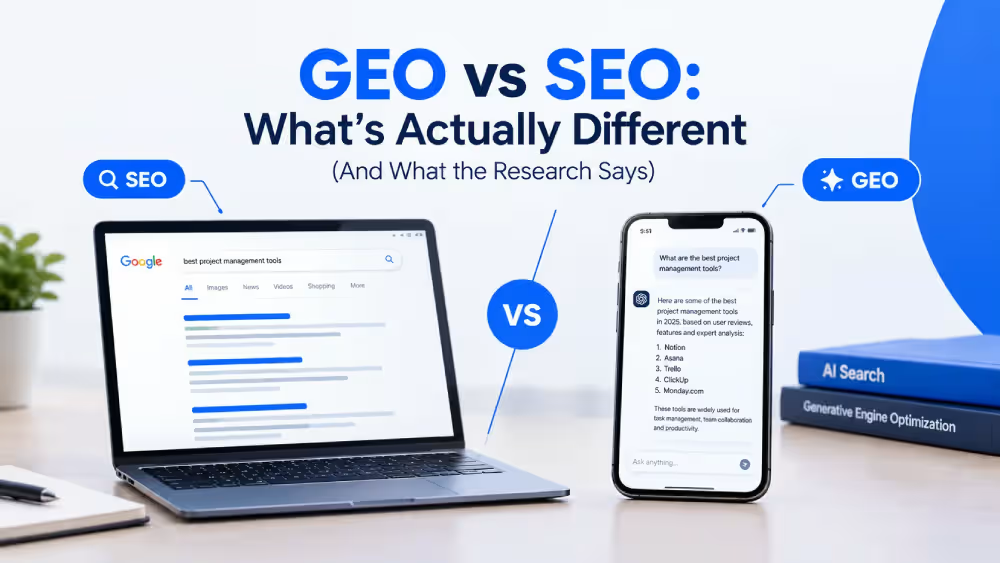
SEO optimises a page to rank inside a list of links. GEO optimises information so a generative AI system chooses to use it inside a written answer. That single distinction explains most of the confusion in the market right now.
In 2026, one widely cited industry analysis reported a 61% click through rate drop on organic results when a Google AI Overview appears above them (Seer Interactive, cited via Conversion System, “GEO vs SEO: Understanding the New Search Landscape,” 2026).
This figure comes from an industry source rather than a peer reviewed study, so treat it as directionally useful rather than an exact universal number. It does explain why marketers suddenly care about a discipline that barely existed three years ago.
SEO still answers the question “will my page appear in the results list.” GEO answers a different question: “will my information get used inside the answer itself, and will I get credit for it.” Both questions matter. They are just not the same question.
The Side by Side Comparison
SEO and GEO diverge most clearly across ten practical dimensions, from what counts as a win to how you actually measure success. The table below lays out the comparison an SEO professional actually needs before deciding where to invest time.
| Dimension | Traditional SEO | GEO |
| Goal | Rank a page in a results list | Get retrieved and possibly cited inside a generated answer |
| Unit of success | A click to your site | A citation, a mention, sometimes a click |
| Query type | One typed keyword matched to a page | A conversational question the system may expand into sub questions |
| Core ranking factor | Keywords, backlinks, technical structure | Query to document relevance, position in the AI’s context |
| Stability | Fairly stable position over time | Visibility that shifts across runs, dates, and platforms |
| Measurement | Rank tracking, click through rate | Citation rate, prominence, fidelity, tracked across repeated prompts |
| Content format | Keyword optimised pages | Clear, structured, self contained facts |
| Typical cost in India | Standard SEO retainer pricing | Roughly 1.8x to 3x standard SEO pricing |
| Failure mode | Losing rank position | Being cited inaccurately, or optimised away from retrieval entirely |
| Platform scope | Primarily one search engine | Multiple systems, each with different sources |
Three of these differences deserve more attention than a table row can give them. The failure mode row matters most, and it is covered in detail below, since it is where most “GEO strategies” quietly go wrong. The platform scope row explains why a single AI citation on one platform tells you almost nothing about your visibility on another. And the cost row is worth knowing before you approve a budget line, covered later in this piece.
Where GEO and SEO Genuinely Overlap
GEO and SEO share roughly 60 to 70% of their required groundwork, according to industry estimates from agencies running both types of programmes (upGrowth, GEO vs Traditional SEO guide, 2026). This overlap is not a coincidence. Both disciplines depend on the same underlying infrastructure: a page has to be crawlable and indexable before any AI system, or any traditional search engine, can find it at all.
The shared foundation includes technical accessibility, genuinely useful content, authoritative sourcing, and a logical site structure. This is worth stating plainly because most competing GEO guides frame GEO as an entirely separate discipline requiring an entirely separate budget. The research reviewed in the pillar article found that AI systems still rely heavily on crawling and indexing infrastructure closely related to traditional search, which means abandoning SEO fundamentals to chase GEO tactics is very unlikely to work.
What genuinely differs sits closer to the surface: how content is structured for extraction, how facts are attributed, and where a source sits once it has already been retrieved. Those differences are covered next.
Where They Genuinely Diverge, and What the Research Actually Supports
Here is the finding that should reset expectations for anyone assuming a Google ranking automatically buys AI visibility: in one peer reviewed audit, 53% of domains cited in Google AI Overviews did not appear in Google’s own organic top 10 results, and 27% were absent from the top 100 entirely (Kirsten et al., cited in Martinez, “A Critical Survey of Generative Engine Optimization,” arXiv:2607.14035v1, 2026). Ranking well and getting cited are related, but they are measurably not the same outcome.
This is also where most industry content starts to overstate its case. Several widely shared “GEO ranking factors” claims circulate without independent verification, for example that well organised headings make a page multiple times more likely to earn an AI citation.
Peer reviewed research offers a more careful picture: a large factorial study covering 252,000 trials across six AI models found that query relevance and position within the AI’s working context are the two most reproducible factors driving citation, not formatting alone (Vishwakarma et al., cited in arXiv:2607.14035v1, 2026). Structural features may help at the retrieval stage without producing the same effect once content reaches the citation stage, so a blanket “structure equals citations” claim does not hold up cleanly.
The clearest divergence, and the one every marketer running GEO work should internalise, is the failure mode. Traditional SEO mistakes usually cost you rank position. GEO mistakes can be worse. One large study, SAGEO Arena, tested what happens when a page’s body text is rewritten purely to look citation friendly.
The rewrite reduced average top 20 presence by roughly 9%, cut top 10 presence after reranking by roughly 16%, and reduced final citations by roughly 6% (Kim et al., cited in arXiv:2607.14035v1, 2026). A page can be made to look more extractable once it is already in front of an AI model, while simultaneously becoming harder to retrieve in the first place.
Do Indian Businesses Actually Need Both?
For most businesses with meaningful organic search dependency, yes, though the right priority order depends heavily on business type. A local coaching institute running “best CA coaching in Delhi” as a core query behaves very differently from a SaaS company selling “best accounting software for Indian businesses,” and the GEO versus SEO balance should reflect that difference.
Transactional and local businesses, where a search still ends in a phone call, a site visit, or a direct purchase, should keep SEO as the clear priority. Google AI Overviews and other AI answers activate less consistently for these queries, and a click still matters more than a mention. Informational and comparison heavy businesses, where a buyer researches extensively before ever contacting a vendor, should weight GEO more heavily, because that is exactly the query type generative answers increasingly intercept.
A simple gut check: if your best converting queries usually start with “best,” “compare,” or “how to choose,” GEO deserves real attention. If they usually start with “near me,” “book,” or “price of,” SEO fundamentals still carry most of the weight.
How to Run SEO and GEO Together Without Wasting Effort
The practical sequence that the underlying research supports is fundamentals first, extractable content second, third party presence third, and separate measurement fourth. The pillar article’s Sections 12 and 13 cover this in depth, so this section stays brief.
Start by protecting what already works: crawlability, indexability, and genuinely useful content remain the floor under both disciplines. Layer extractable facts on top, meaning clear definitions, verifiable statistics, and direct answers to the exact questions your audience asks. Build real presence beyond your own website through legitimate third party mentions, since AI systems draw from a wider pool of sources than any single page. Finally, measure GEO and SEO as separate metrics, not one blended number, because a citation and a click are genuinely different outcomes.
One caution worth repeating from the divergence section above: do not let a GEO vendor rewrite your core pages purely to chase citation friendliness without checking the effect on retrieval first. The SAGEO Arena finding is a direct warning against exactly that shortcut.
What GEO Costs in India Right Now
GEO and AEO retainer pricing in India currently ranges from roughly ₹75,000 to ₹3,50,000 per month for mid market engagements, with global agencies charging $1,500 to $25,000 monthly for comparable scope (upGrowth, GEO AEO Pricing Benchmark India, 2026). This is industry reported market pricing data, not academic research, and it should be treated as a budgeting input rather than a benchmark to hit.
The pricing premium over standard SEO retainers, reported at roughly 1.8x to 3x, reflects the additional testing overhead GEO genuinely requires: multiple AI platforms, repeated prompts, and separate fidelity checks all add real labour on top of standard SEO work. Before approving a GEO specific budget line, it is worth asking a vendor exactly which of the seven visibility stages, covered in the pillar article’s visibility vector breakdown, their retainer actually measures. A vendor who can only show you citation screenshots is not measuring the full picture.
Frequently Asked Questions
Is GEO replacing SEO?
No. The underlying research reviewed in the pillar article found no reviewed technique with a stable, durable effect on organic discoverability that operates independently of solid SEO fundamentals. GEO adds a layer on top of SEO rather than replacing it.
What is the difference between AEO and GEO?
AEO, or answer engine optimisation, and GEO overlap substantially, roughly 70% of the work by some industry estimates. AEO leans toward featured snippets, People Also Ask boxes, and zero click answers on Google and Bing. GEO extends further into generative AI systems such as ChatGPT, Perplexity, and Gemini, including platforms where AEO tactics have limited reach.
Does ranking well on Google guarantee AI citations?
No. One peer reviewed audit found that 53% of domains cited in Google AI Overviews did not appear in the organic top 10 at all. Ranking and citation are related but measurably distinct outcomes.
Do small businesses need to invest in GEO separately from SEO?
It depends on query type more than business size. A business whose best queries are transactional or local, such as “near me” or booking related searches, should prioritise SEO. A business whose queries are comparison or research heavy should weight GEO more seriously.
How much does GEO cost in India?
Industry reported figures put mid market GEO and AEO retainers at roughly ₹75,000 to ₹3,50,000 per month, a premium of about 1.8x to 3x over comparable SEO retainers. This is market pricing data, not an academic benchmark, so treat it as a planning input rather than a fixed rule.
Conclusion
The overlap between GEO and SEO is real, and so is the divergence. Most of the groundwork, crawlability, content quality, and authoritative sourcing, genuinely serves both disciplines at once. Where they split apart, ranking position, citation likelihood, and failure modes, the evidence is still developing, and a meaningful share of what circulates online as “GEO best practice” has not been independently verified.
The most defensible position right now is to treat GEO as a layer that sits on top of SEO, not a replacement for it. Keep your fundamentals strong, test GEO tactics carefully before committing budget to a full rewrite, and measure citations separately from clicks. For the full research picture, including the seven stage visibility pipeline and a practical audit checklist, see the pillar article, “Generative Engine Optimization (GEO): What Research Really Says.”
Sources
- Olivier Martinez, “A Critical Survey of Generative Engine Optimization,” arXiv:2607.14035v1, retrieved 2026-09-18, https://arxiv.org/abs/2607.14035
- upGrowth, “GEO vs Traditional SEO: What’s Changed in 2026 and What You Should Do About It,” retrieved 2026-09-18, https://upgrowth.in/?p=51084
- upGrowth, “GEO AEO Pricing Benchmark India 2026: What Retainers Actually Cost,” retrieved 2026-09-18, https://upgrowth.in/geo-aeo-pricing-benchmark-india-2026/
